

What is Business Intelligence, and how come it essential?
Business Intelligence (BI) describes the tools, strategies, and systems that businesses use to analyze information and acquire actionable insights. With international information generation rising tremendously, organizations count on BI to make informed choices quicker, find styles, and optimize processes. Integrating Business Dashboards into everyday procedures allows teams to recognize inefficiencies, prediction market styles, and enhance customer activities centered on data-backed evidence.
Which industries benefit probably the most from BI ownership?
While BI is valuable across all areas, industries such as for instance financing, retail, healthcare, and production have experienced the best impact. Retailers, for instance, use BI dashboards to track catalog turnover and customer conduct patterns, whereas healthcare services power analytics for individual result optimization and resource allocation. Statistics indicate that agencies applying BI methods report a 127% higher likelihood of increasing decision-making quality.
.png?width=958&name=IFBI%20Dashboard%20(3).png)
What are the most recent trends in Business Intelligence?
AI-Powered Analytics – Artificial Intelligence and unit learning are enabling predictive ideas, anomaly detection, and automation in data analysis.
Self-Service BI – Non-technical team is now able to access dashboards and create reports without relying greatly on IT teams.
Real-Time Knowledge Checking – Contemporary BI platforms allow live tracking of KPIs, ensuring quick ideas for timely decisions.
Portable BI – Opening dashboards via mobile phones guarantees executives and subject staff stay educated on the go.
How can companies measure the ROI of BI?
Testing ROI involves analyzing improvements in efficiency, revenue development, and cost reduction. For example, a retail company might visit a 20% reduction in stockouts after implementing BI resources, while a logistics organization might reduce distribution setbacks by 15% through predictive analytics. Regular KPI monitoring and efficiency dashboards are key to quantifying these benefits.
What challenges do agencies face in BI use?
Frequent obstacles include knowledge silos, poor data quality, and opposition to change. Overcoming these difficulties needs appropriate governance procedures, clean data practices, and government help to foster a data-driven culture.
How are dashboards surrounding decision-making today?
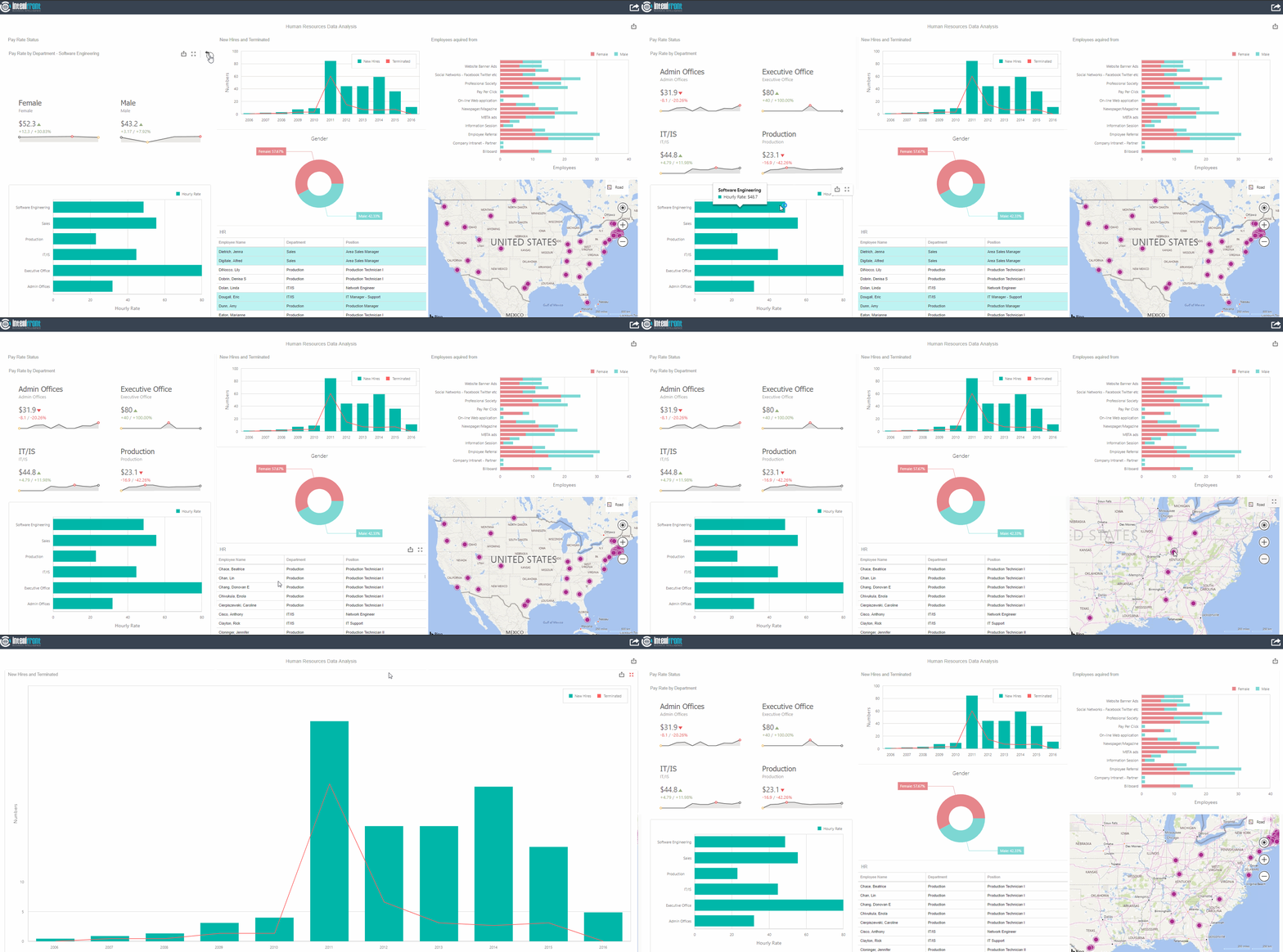
BI dashboards provide a visual snapshot of critical metrics, rendering it simpler to identify developments and anomalies quickly. Professionals may compare famous information, monitor efficiency against goals, and produce evidence-based choices in true time. In accordance with industry study, businesses using active dashboards knowledge an one month quicker reaction charge to critical Business issues.
What characteristics should modern BI computer software contain?
Effective BI platforms present user-friendly dashboards, computerized reporting, predictive analytics, real-time alerts, and integration with active enterprise systems. Safety and scalability may also be important to ensure sensitive data is secured while promoting organizational growth.
How is information governance connected to BI success?
Appropriate information governance ensures precision, uniformity, and conformity, which are crucial for BI effectiveness. Without obvious governance, studies and ideas could be inaccurate, resulting in poor decision-making.
Can AI change individual analysts in BI?
AI promotes analytics but does not change human insight. Analysts understand information, offer context, and align ideas with Business strategy. The mixture of AI-driven analytics and expert judgment provides the most impactful results.
Just how can organizations stay forward with BI in 2026?
Businesses should spend money on scalable BI programs, prepare staff in data literacy, and continuously consider KPIs arranged with proper objectives. Embracing emerging systems like AI, organic language running, and predictive modeling guarantees companies remain agile and aggressive in the data-driven landscape.